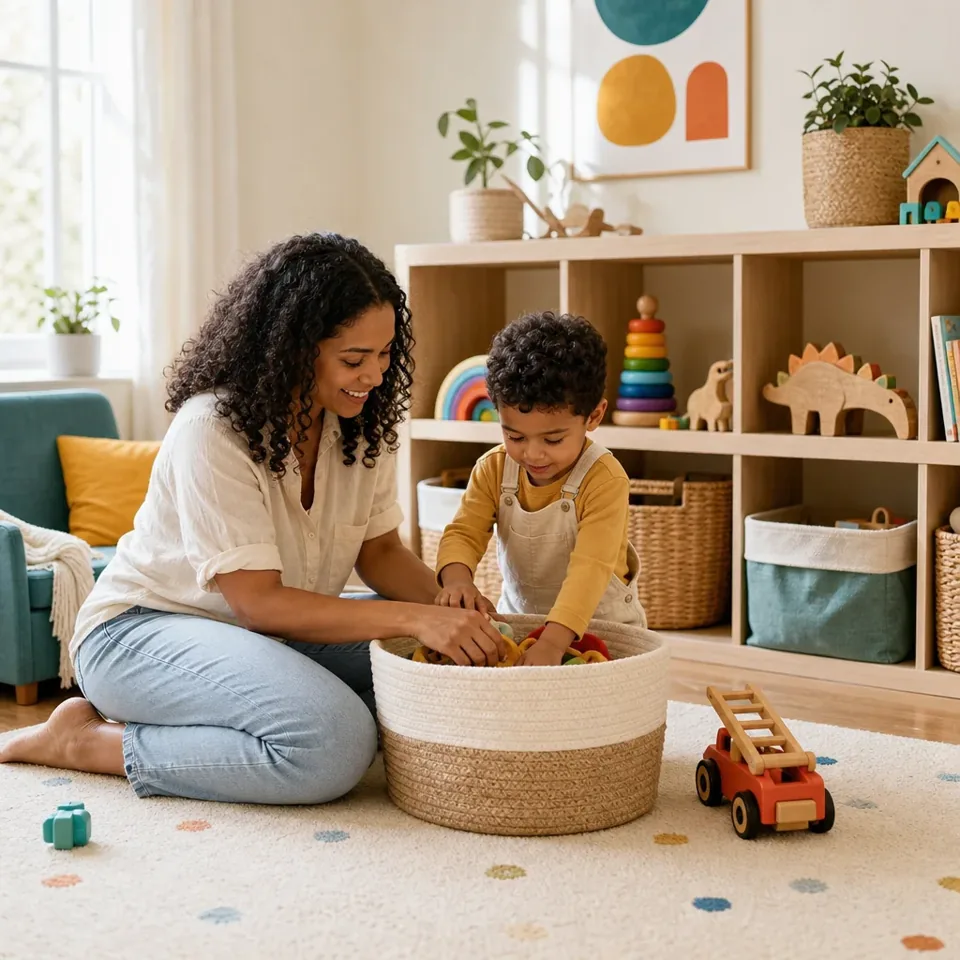
Keep the pieces needed for one activity together when practical. Use a manageable number of categories, with adult-controlled storage for items that should not be freely accessible.
Observe where cleanup breaks down
For one normal play session, note what gets scattered, what children can recognize, and which containers require adult help. A deep mixed bin may hide a needed piece; many tiny labeled boxes may create more sorting than anyone wants to do. The right category size depends on the people using it.
Separate broken items and incomplete sets for adult review. Do not return a damaged toy to circulation because its storage space is empty. Follow the toy's age, use, maintenance, and parts warnings; organization does not make an unsuitable toy appropriate.
| What happens | Try this organizational change |
|---|---|
| One activity is spread across several bins | Group its essential pieces together. |
| Children cannot identify the return location | Use a recognizable picture or simpler category. |
| Every cleanup becomes a detailed sorting job | Use fewer categories and review whether exact sorting matters. |
| Small parts mix with younger children's toys | Separate access and supervision arrangements, not just labels. |
Try one zone before changing the room
Choose a small group of activities and a temporary arrangement using suitable containers you already have. Walk through getting an activity out, playing, and returning it. This helps identify whether the real issue is missing space, too many categories, or an activity with more pieces than you want available at once.
Check the furniture and containers themselves. Storage furniture can introduce tip-over hazards; follow CPSC's Anchor It guidance and the manufacturer's instructions. Labels and a tidy appearance do not address stability, lids, cords, or climbable arrangements.
Check items as you work through this list. These ticks reset on reload.
Keep the system changeable
Interests and abilities change. Revisit categories when a shelf is repeatedly ignored or a bin cannot be closed. Giving away items should be a separate family decision, not a surprise hidden inside a cleanup exercise.
Set up the activity before choosing a storage product
Choose one activity your child uses often. Put the pieces needed for it together, with a place they can return to afterward. Keep damaged or incomplete items in an adult-controlled place for checking, rather than mixing them back into the activity bin. Follow age and use instructions for toys and play equipment, especially in a room used by children with different needs.
A play mat or activity gym also needs a use space, a cleaning method, and somewhere to go when the activity ends. Read the exact product’s instructions before arranging attachments or replacing components. A play area is not an infant sleep space; if a baby falls asleep, follow the CPSC’s sleep guidance rather than treating supervised play equipment as a sleep product.
Run a one-area experiment
Try one shelf before reorganizing the room
Put drawing supplies where drawing happens
A household repeatedly finds crayons and paper in separate rooms. They put an appropriate working set together near the activity space, with adult control where needed. After a few uses, they check whether setup and cleanup require fewer searches. The success measure is an easier activity, not a photograph of matching containers.
Label with the words or pictures useful to the people doing the reset. “Drawing” may work better than “miscellaneous craft materials.” Do not expect a young child to sort a system designed around an adult’s aesthetic. Simplify the categories until putting away an activity is understandable with the help your child needs.
Make the maintenance job visible
Pick an adult to check for damaged pieces, follow cleaning instructions, and decide what stays in use. Put loose packaging, batteries, and small components where they do not create child-access hazards. For shelving and storage furniture, follow the product instructions and CPSC’s furniture-anchoring guidance; a low or attractive shelf is not a safety assessment.
Make it your own
One-area play-space experiment
Use the fields for your practical notes, then print a copy for the handoff. Entries stay on this page and reset on reload.
These fields do not save or send your entries. Avoid private health, access, or contact details. Without JavaScript, you can still fill in and print the page with your browser.
The basis for this guide
Sources & editorial notes
Primary sources support the health, safety, and technical statements linked above. Worked examples and household worksheets are practical illustrations prepared for this guide; they are not product tests.
Revised October 8, 2026. No independent medical or specialist review is credited to this edition. Read our editorial standards.
Illustrative imagery accompanies our guides; it does not document testing, a reader’s home, or a clinical assessment.
Report a correction ↗