Keep component instructions, product directions and machine settings together. Do not replace them with a universal temperature or dose from a different household.
List the components before writing the cycle
A collection may include absorbent pieces, covers, pocket shells, fasteners, liners and storage bags. Identify each item from its own label and keep its current care instructions. Pieces used together during a change may still have different washing or drying requirements. Put uncertain or unreadable labels on a questions list rather than guessing from appearance.
GroVia's laundry information is one example of manufacturer-specific guidance. Use the equivalent instructions for your actual collection and washing machine. If the machine manual, detergent directions and component instructions appear to conflict, ask the relevant manufacturers before improvising a compromise.
Describe the handling sequence
Write where used items wait, how they are handled and which instructions apply before laundering. The CDC's home diaper-changing steps include handling used cloth diapers and hand hygiene. Keep those hygiene steps separate from choosing the machine programme. Store products and used items outside the child's access, and avoid creating an accessible soaking container.
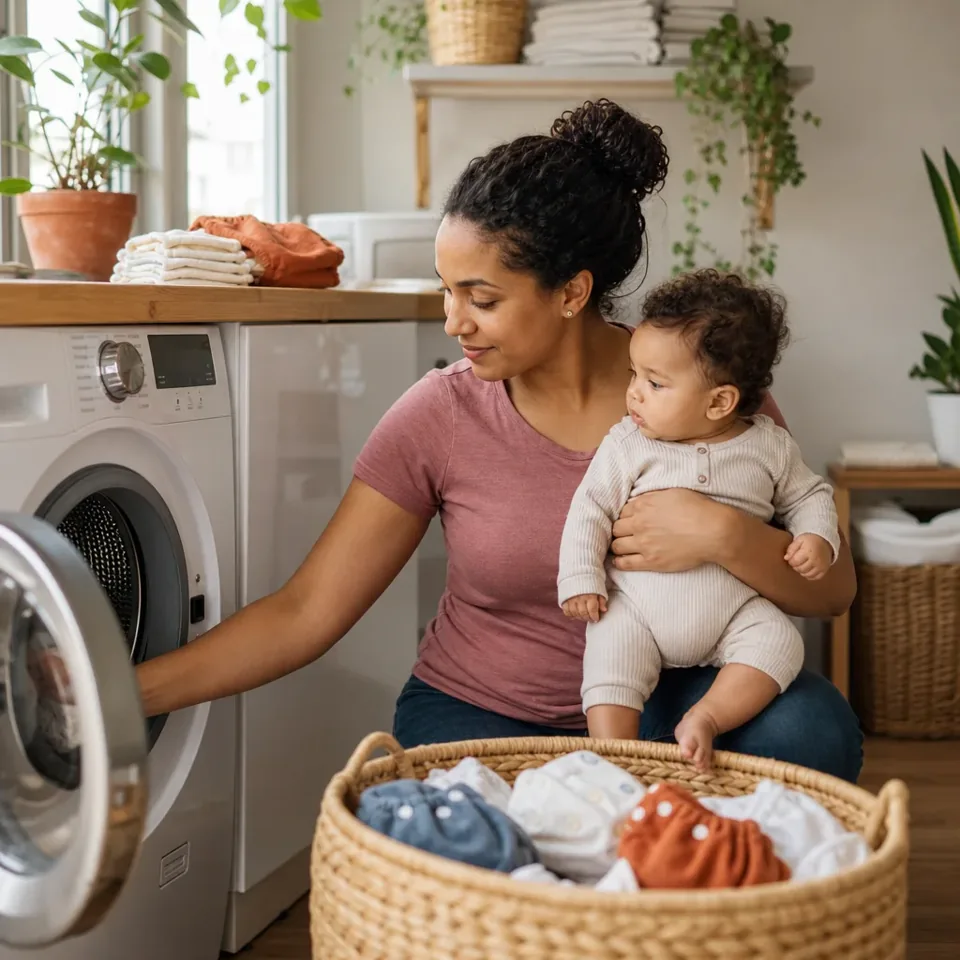
For the wash itself, copy the applicable directions accurately: component preparation, permitted detergent, the stated dose for the conditions, machine programme and drying restrictions. Do not add optional products just because they appear in another family's routine. Make clear where the clean, fully dry items go and who checks they are ready before assembling them.
Keep an observation log, not a string of experiments
If a result is unsatisfactory, record what you can observe and the exact routine used. Avoid changing several products and settings at once, because that makes the next conversation harder to reconstruct. A recurring odour, leak, damaged elastic or question about a baby's skin may require different kinds of advice. The wash log is information for that conversation; it is not a diagnosis.
A household handoff example
Clean absorbent pieces, wet covers
An invented family washes on a regular schedule but assembles each change too early. Its log shows that one component is still drying when the others are ready. They add a separate “ready to assemble” check and identify a place where pieces can finish drying according to their instructions. Their inventory calculation then includes the extra turnaround time. They do not change the chemical routine to solve what is currently a scheduling observation.
Make it your own
Write the actual wash-to-ready sequence
Use the fields for your practical notes, then print a copy for the handoff. Entries stay on this page and reset on reload.
These fields do not save or send your entries. Avoid private health, access, or contact details. Without JavaScript, you can still fill in and print the page with your browser.
Use the log to troubleshoot persistent diaper-laundry problems and allow for washing and drying in your stock calculation.
The basis for this guide
Sources & editorial notes
Primary sources support the health, safety, and technical statements linked above. Worked examples and household worksheets are practical illustrations prepared for this guide; they are not product tests.
Revised October 31, 2026. No independent medical or specialist review is credited to this edition. Read our editorial standards.
Illustrative imagery accompanies our guides; it does not document testing, a reader’s home, or a clinical assessment.
Report a correction ↗